



Artwork by Iain Faulkner15 Artworks
Iain Faulkner
Iain Faulkner – Artist Biography
Scottish artist Iain Faulkner graduated from Glasgow School of Art in 1996 with a BA in Fine Art. Since then, he has established an international exhibition presence, presenting solo shows across the UK, USA, France, Switzerland, Spain and Italy. His paintings are held in numerous private and corporate collections, and in 2010 he received the prestigious commission to paint portraits of the European Ryder Cup Team.
The Urban Landscape
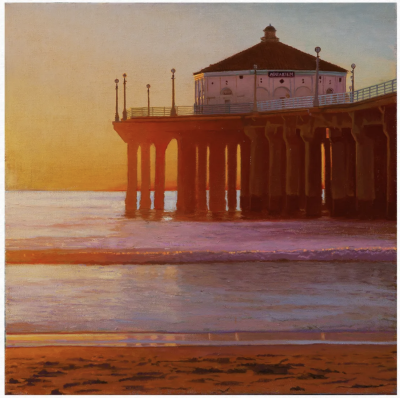
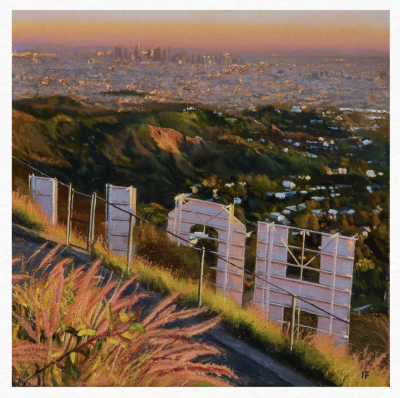
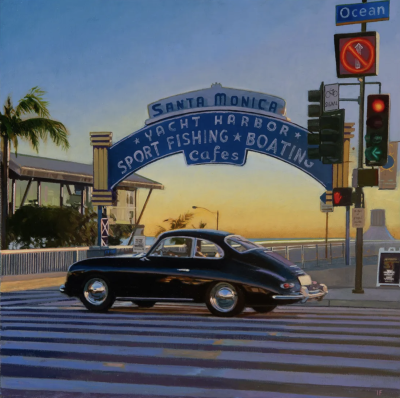
In his more recent paintings, Faulkner turns his attention to the extraordinary scale and complexity of the modern city. Through sweeping aerial perspectives, he transforms the urban environment into a richly detailed tapestry of architecture, geometry and colour. Los Angeles provides a compelling subject, its seemingly endless sprawl stretching towards the horizon in an intricate arrangement of buildings, roads and neighbourhoods.
Faulkner demonstrates exceptional sensitivity to atmosphere and distance. From his elevated viewpoints, the city unfolds beneath shifting Californian skies, where the soft haze of the atmosphere gradually dissolves architectural details into the distance. Subtle changes in tone and definition create a convincing sense of depth, while vibrant pinks, golden yellows and cool blues evoke the distinctive light of a sunset over the sprawling metropolis.
Each composition reveals the artist’s meticulous approach to structure and form. Buildings become an intricate arrangement of geometric shapes, their varied colours and patterns carefully balanced to create a harmonious whole. Occasional glimpses of trees and foliage offer moments of contrast against the vast expanse of the built environment, highlighting the relationship between the natural world and the city’s relentless expansion.
A City Without End
Viewed from the heights of the Hollywood Hills, Faulkner’s cityscapes offer a perspective that is both detached and immersive. Human figures are absent, leaving architecture and urban structure to dominate the scene. From this distance, the city appears almost limitless: a vast, self-sustaining network of streets, buildings and destinations.
There is an intriguing tension between the precision of Faulkner’s compositions and the sheer magnitude of the landscapes he depicts. His paintings invite us to contemplate the modern city as a place of endless possibilities, where countless individual lives and stories unfold beyond our view.
Like a contemporary labyrinth, the metropolis stretches outwards without an obvious centre, its intricate patterns suggesting an infinite number of routes, experiences and unknown outcomes. Through his remarkable command of perspective, colour and architectural detail, Faulkner captures not simply the appearance of the city, but its scale, complexity and enduring fascination.
Filter


Iain Faulkner

Iain Faulkner – Artist Biography
Scottish artist Iain Faulkner graduated from Glasgow School of Art in 1996 with a BA in Fine Art. Since then, he has established an international exhibition presence, presenting solo shows across the UK, USA, France, Switzerland, Spain and Italy. His paintings are held in numerous private and corporate collections, and in 2010 he received the prestigious commission to paint portraits of the European Ryder Cup Team.
The Urban Landscape
In his more recent paintings, Faulkner turns his attention to the extraordinary scale and complexity of the modern city. Through sweeping aerial perspectives, he transforms the urban environment into a richly detailed tapestry of architecture, geometry and colour. Los Angeles provides a compelling subject, its seemingly endless sprawl stretching towards the horizon in an intricate arrangement of buildings, roads and neighbourhoods.
Faulkner demonstrates exceptional sensitivity to atmosphere and distance. From his elevated viewpoints, the city unfolds beneath shifting Californian skies, where the soft haze of the atmosphere gradually dissolves architectural details into the distance. Subtle changes in tone and definition create a convincing sense of depth, while vibrant pinks, golden yellows and cool blues evoke the distinctive light of a sunset over the sprawling metropolis.
Each composition reveals the artist’s meticulous approach to structure and form. Buildings become an intricate arrangement of geometric shapes, their varied colours and patterns carefully balanced to create a harmonious whole. Occasional glimpses of trees and foliage offer moments of contrast against the vast expanse of the built environment, highlighting the relationship between the natural world and the city’s relentless expansion.
A City Without End
Viewed from the heights of the Hollywood Hills, Faulkner’s cityscapes offer a perspective that is both detached and immersive. Human figures are absent, leaving architecture and urban structure to dominate the scene. From this distance, the city appears almost limitless: a vast, self-sustaining network of streets, buildings and destinations.
There is an intriguing tension between the precision of Faulkner’s compositions and the sheer magnitude of the landscapes he depicts. His paintings invite us to contemplate the modern city as a place of endless possibilities, where countless individual lives and stories unfold beyond our view.
Like a contemporary labyrinth, the metropolis stretches outwards without an obvious centre, its intricate patterns suggesting an infinite number of routes, experiences and unknown outcomes. Through his remarkable command of perspective, colour and architectural detail, Faulkner captures not simply the appearance of the city, but its scale, complexity and enduring fascination.
Loading